Friday, 21 October 2011

A Fête-Dieu Procession in Paris: Now and Then


This is a photo from a Fête-Dieu procession that I took when I was in Paris in June this year. As part of my research on eighteenth-century religious art in Parisian parishes, I've been looking into the history of these processions during the early modern period and so was keen to get some sense of the experience even at this historical remove. The traditionalist parish of Saint-Nicolas-du-Chardonnet is now one of the only parishes left in the city that still performs the ritual.

Fête-Dieu (or Corpus Christi) is a moveable feast of the Roman Catholic Church (and some other Christian churches) celebrated annually in the week after Trinity Sunday (usually falling in May or June). The feast originated as a practice in the thirteenth century, and liturgically it commemorates the ritual of the Eucharist.

By the eighteenth-century, however, the feast day was not only theologically significant, but had also become a key community event in the urban calendar. One of the key rituals associated with the feast is the procession in which the consecrated Host is carried out of the church and into the streets of the parish so that all the community could witness and celebrate the Body of Christ. Each parish had its own procession in which the clergy and congregation would walk through and around the parish, marking its boundaries, and thus celebrating (or at least demarcating) the spaces encompassed by the local community.

Place Dauphine on Turgot's 1739 map of Paris
Fête-Dieu holds significance for art historians of eighteenth-century France because of the material and visual impact of these processions. During this feast, the church was, to a certain extent, turned inside out, as the streets were decorated with banners and paintings to honour the passing Host. Moreover, until the Académie's Salon exhibitions were inaugurated in 1737, Fête-Dieu was also the occasion for the city's only public art exhibition at Place Dauphine, an annual display where artists exhibited their works outside in the square (seen here on Turgot's map at the end of what is now the Île de la Cité).

Contemporary Fête-Dieu Procession route (base map from Google)
As I said at the start, Saint-Nicolas-du-Chardonnet is now the only parish in Paris that still celebrates the feast. I was expecting the route of the procession to mark out the parish boundaries as it did in the eighteenth century, but it seems the procession is no longer a strictly local event. As you can see from the route that I mapped as we walked (left), the Saint-Nicolas-du-Chardonnet procession is far from confined to the 5th arrondissement. It begins at the church, but then makes its way to the Seine, crossing onto the Île de la Cité and then onto the Right Bank. Proceeding along the Quai de l'Hôtel de Ville, it then crosses back onto the Île Saint Louis, stopping briefly at a temporary altar on the Pont de la Tournelle where the host is elevated (with the Cathedral of Notre-Dame as a backdrop - as you can see in the photo below), before the procession moves back into the 5th arrondissement and returns to the church. With hundreds of participants walking and chanting, while altar boys swing incense from thuribles, and little children sprinkle flower petals, the procession, not surprisingly, causes a significant interruption to city life. Stopping traffic as it moves along occupying the full width of streets (for nearly two hours in total), the whole event is controlled by the police with patrol cars and metal barricades strategically placed along the route.
Temporary altar on procession route with Notre-Dame in the background
It was fascinating to witness how this medieval ritual has survived and yet how much it has clearly evolved, not just since the Middle Ages, but since the eighteenth-century... from a local community event in which neighbourhoods came together to celebrate... to a city-wide proclamation of traditionalist Roman Catholic belief which most Parisians now seem to greet with impatience.

Tuesday, 20 September 2011

The Mysterious Suicide of François Lemoyne

I’m doing the AAH’s Art History in the Pub this month, which means I get another chance to talk about François Lemoyne’s suicide. This has come out of the research I’ve been doing with Katie Scott (Courtauld Institute of Art) on Artists’ Things (website launching soon!) and the material culture of artists in eighteenth-century France. This time I'm focusing a little bit less on the sword itself, and a little bit more on the suicide... and maybe this time, in true CSI:18thC Paris style, the mystery will be solved!

Art History in the Pub is free and open to all. It's at 7:30 on 26th September at The Monarch in Camden. The abstract is below and further details are available on the AAH website.

The Violent Suicide of François Lemoyne
An 18th-Century Art History Mystery

18th-C French Sword - Photo: V&A
Paris, 4 June 1737: the celebrated artist François Lemoyne commits suicide. It started as an ordinary day. Lemoyne had been to his studio to give a lesson to his students and taken a meal with his cousin. But then events took a macabre turn. Lemoyne retired to his bedroom, carefully locked the door, took up his sword, and proceeded to inflict upon his body multiple fatal stab wounds, before dropping to the floor and dying in a pool of blood.

Lemoyne’s death shocked and horrified his family and colleagues, and it has since presented something of a mystery for art historians. Why should this incredibly successful artist – first painter to Louis XV – have wanted to kill himself only months after completing what is now considered his magnum opus: the ceiling of the Apotheosis of Hercules at the Château de Versailles? Was it over money? Professional jealousy? A madness induced by lack of recognition? Could it have been murder? Or if it really was suicide, then how did Lemoyne complete his gruesome task?

With most of the clues now lost deep in the past, some art-historical sleuthing is necessary in order to retrieve the traces. In this paper, I attempt to solve these perplexing mysteries through a forensic and art-historical analysis of the object responsible: Lemoyne’s sword. Using police reports, autopsies, and witness statements, I piece together the final hours of Lemoyne’s life and offer a material reconstruction of the now lost fatal weapon, exploring what Lemoyne’s sword looked like, what he did with it, and what it meant to him. Drawn from a larger study investigating what artists’ personal possessions reveal about their everyday lives, this case explores the limits and possibilities of object-biography, and presents an exercise in recovering the material history of an object when that object no longer materially exists.

Tuesday, 16 August 2011

Art History in the Pub


The Monarch - Photo Source: Qype

What could be better than an evening of art history? An evening of art history with beer! The ever-enterprising Association of Art Historians has recently launched a new series called Art History in the Pub, a monthly series of talks and presentations by art historians in a London pub (organised by Dr Matt Lodder). Designed as a fun and accessible forum for the communication of art-historical scholarship and the discussion of current debates in the discipline, this is, as the AAH notes, a great way of “bringing the best of cutting-edge art-historical research to a wider community”. I imagine it’s also a great way to spend a Monday evening.

I’ve been invited to speak at the September gathering (on 26 Sept), so I’ll be posting soon about the presentation that I’ll be giving (on the mysterious suicide of François Lemoyne!), but in the meantime, the next Art History in the Pub is on Monday 22 August with Dr. Petra Lange Berndt of UCL, talking about ‘Taxidermy and Colonial Practice’.

Proceedings kick off at 7:30 and the pub is The Monarch (40-42 Chalk Farm Road, Camden, London, NW1 8BG). Entry is free.

Friday, 8 July 2011

Portraiture and Time in the Age of Enlightenment (ISECS 2011, Austria)

At the end of the month I'm going to Austria for the 13th International Congress of ISECS (International Society for Eighteenth-Century Studies), also known as SIEDS in France (Société internationale d'étude du XVIIIe siècle). The Society has a large conference every four years - like the Olympics for eighteenth-centuryists! - which brings together scholars from all sorts of fields (history, literature, philosophy, art history, language studies) working in all kinds of thematic and geographic areas, who share the one common trait of being eighteenth-century-centric.

This year the conference is being held in Graz (25-29 July 2011) and most of the sessions are related to two main themes: 1) Time in the Age of Enlightenment: Situating the Present, Imagining the Future; and 2) Central and Eastern Europe in the Age of Enlightenment. I'm going to be giving a paper in a session organised by Heather McPherson on Portraiture and Time. Here's a short abstract to give a sense of what it's about:

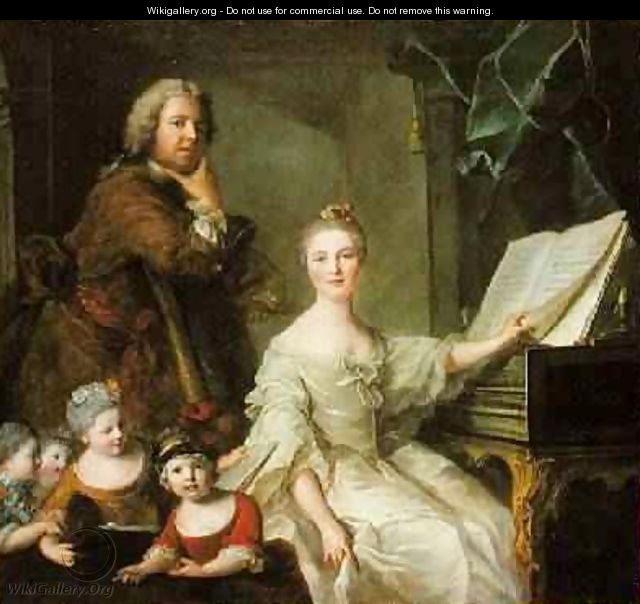
Jean-Marc Nattier, Self-Portrait with his Family, 1762 (Source: Wikigallery.org)
 
Painting Against Time: Alternative Temporalities in the Portraits of Jean-Marc Nattier and Louis Tocqué
This paper explores the suspension of time in portraits by Jean-Marc Nattier and Louis Tocqué, two of the most celebrated portraitists of eighteenth-century France, who were also, at different times in their lives: master and student, colleagues at the Académie Royale, and father- and son-in-law. Through an analysis of the portraits that Nattier and Tocqué painted of themselves and each other across their lives, I explore how these artists played with time to negotiate their changing professional and personal relationships. Tocqué was only ten years younger than his master and father-in-law, but in the pictorial realm, time could be suspended to visualise a more appropriate age gap which had never existed in life. I argue that in Nattier and Tocqué’s portraits and self-portraits, we encounter efforts to construct alternative temporalities in which their relationships were normalised. Through close visual analysis of these objects that marked, commemorated and reinforced professional and familial relationships, this paper reveals how portraiture permitted a temporal fluidity that allowed the objects’ makers to play with reality: to go back in time, to distort the fabric of time, to slow down, to speed up, to preserve moments or even invent them.

Friday, 1 July 2011

Art’s Insiders: New Histories of Europe’s Academies

I'm organising a session with my colleague Keren Hammerschlag exploring new histories of Europe's art academies at the 2012 Association of Art Historians (AAH) conference, which is going to be held next March at the Open University in Milton Keynes.

Courtauld Gallery's 'Art on the Line' Royal Academy exhibition in 2001 (Photo: Courtauld Gallery)

Our aim is to re-interpret the place of academies in the early modern art world, and to start re-conceptualising the histories that have been constructed of these institutions in art history. Here's the call for papers (submissions due by 7 November 2011):

For centuries, institutions like the Royal Academy in London, the Académie Royale (later the Académie des Beaux Arts) in Paris, and the Accademia di San Luca in Rome were the epicentres of European art practice, theory and education. For artists, having the letters ‘RA’ after their name, or the opportunity to show works at the Salons or the Summer Exhibitions promised elevated social standing and commercial success. As institutions, Academies developed principles and ideals that dominated artistic production throughout the period. In art history, however, the ‘Academy’ has been variously recast as staid, kitsch and archaic. According to critics, ‘academic’ art represents the inert centre against which avant-garde innovation and originality was pitted. But in their time, Europe’s Academies were anything but static or homogenous. Established by groups of artists resisting under-developed or conservative attitudes to art, these communities often began as innovative alternatives; they were home to radical new approaches, and became sites of heated debate in response to political, theoretical and social shifts.

This session seeks a re-evaluation of art’s insiders. What did it mean to be at the centre of these powerful institutions? And how can we effectively revisit the Academy without falling into the trap of reviving dead, white, male, bourgeois artists? We invite proposals for papers that take a new look at the ‘Academy’ and academicians in the period 1600 to 1900. Papers might address issues of gender, social networks, individual and collective identity, educational practices, centre and periphery (eg. regional academies), in-groups and rivalries, competition and emulation, successes and failures. In particular we invite papers informed by sociological, anthropological and cultural theory approaches, which take art objects as their focus.

For more information on our session click here, and for other sessions at the conference click here.

Monday, 20 June 2011

New Ways through Old Maps: Artistic Communities in 18th-Century Paris

As part of my research on 18th-century French religious art, I've been doing significant archival work on artists and parish life in Paris. A large part of this involves finding ways of reconstructing local artistic communities, and a large part of that is mapping.

Artistic communities mapped using Google maps
I've been using Google maps, for instance, to map the locations of parish churches and artists' addresses and other key sites to get a sense of how people inhabited the early modern city. I've been building up a rich picture of the demographies and geographies of 18th-century artistic communities in Paris, mapping where these communities were concentrated, and tracing artists' social networks at the local 'neighbourhood' level. (I'm going to be presenting some of this material next week in Paris at the Art & Sociability conference that I mentioned in my last post).

What I kept finding myself wanting, however, was a 'historical' Google maps.

Plan de Turgot (Source: Kyoto University)
For an intimate sense of early modern Paris, my favourite map is the Plan de Turgot. It was commissioned by Michel-Étienne Turgot (prévôt des marchands de Paris) in 1734, and completed by Louis Bretez (architect and master of perspective) in 1739. Bretez and his team of map makers went all over the city, into private courtyards and gardens, drawing pictures and taking measurements, to produce a map in isometric perspective with incredible detail of individual streets and residences. All the sections of the map have been digitised by the University of Kyoto and are available online.

But the urban structure of Paris changed considerably in the 19th century. Baron Haussman's renovation of the streets of Paris in the 1850s and 1860s dramatically altered the fabric of the city, razing buildings and entire streets to make way for his network of boulevards. For an 18th century-ist, sometimes it's difficult to imagine what the city was like a hundred years earlier. Before the Louvre had its large symmetrical wings, for example, the area around the palace was made up of little residential streets with shops and churches, and before the quays of Paris became roads, they were functioning ports.
Louvre in 1739 (Source: Kyoto Uni)
Louvre in 2011 (Source: Googlemaps)


I've spent many hours in Paris wandering around streets with printed bits of Turgot's map trying to work out where things were... fun but not very effective. It gave me a great sense of the early modern city, but apart from lots of coloured annotations on bits of paper, no way of visualising it.

Bridging that disconnect between the 18th century and today - between Turgot's Paris and Google's Paris - became a lot easier a few months ago when Mia Ridge drew my attention to some fantastic sites which I've found both useful (as research tools) and inspiring (as visualisations of urban history research).

Plan de Turgot over Google maps using Georeferencer
One was Georeferencer - a georeferencing tool that is solving exactly that disconnect by allowing the comparison of old maps with modern. Using three or more geographic reference points that haven't changed between the 18th century and today, I was able to overlay Turgot's 1739 map and Google maps and ended up with this. Now I could work out much more quickly where certain 18th-century streets were in relation to modern streets, and how and where the city has changed most significantly.

Paris in 1797 superimposed over Paris today (Hypercities)
Another fantastic site was Hypercities, where all this overlaying is already done for you using historical maps in excellent resolution. They have maps for many cities all over the world, including Berlin, Lima, London, New York, Saigon, Tehran, Tel Aviv and Tokyo. Beyond the extensive geographic coverage, there are two things that make Hypercities so useful. First is the historical coverage: each city has several maps (for Paris there are maps from 1705, 1797, 1860, 1863, 1865, 1867, 1900, 1920) so you can get a sense of how the city is changing at different points, and when major expansions occur. Second, and probably most useful, is the opacity function, which allows you do make the historical map more or less transparent so that Googlemaps (or the satellite view) is easier to see underneath. As you move the opacity slider, it really feels like you're zooming between two centuries.

And if you're imagining how great it would be to have this on a mobile device with GPS, so you could wander quite literally through the streets of the past, then look no further than Look Back Maps, who have developed an iPhone app which locates historical data on contemporary maps (video demo). Another similar technological activation of historical geographies and archives is Philaplace, a local urban history project of Philadelphia using maps, photos and other data, which I've already blogged about here.

Saturday, 21 May 2011

Art and Sociability in the Eighteenth Century


At the moment I'm writing a paper for this colloque happening in Paris at the INHA on 23-25 June. The organisers have brought together a really exciting looking programme of speakers from France, the USA, Germany and the UK to discuss ideas in response to the following call:

"Over the past two decades, sociabilité has become a useful and hotly debated concept for discussing the social, political and cultural changes during the eighteenth century. The works of Daniel Roche, Dena Goodman, Daniel Gordon, Antoine Lilti, and others have demonstrated that sociabilité can be fruitfully approached from the perspectives of sociology, philosophy and anthropology. In the eighteenth century, the Encyclopédie defined the term as “This inclination we have to do to others all the good that we can, to reconcile our happiness with that of others, and always to subordinate our personal advantage to the overall and communal advantage” (Louis de Jaucourt, 1751-1765) – that is, it was an abstract concept that explained the desire humankind had to participate in society.  At the time, it was intricately linked to the social practice of commerce, broadly defined as any reciprocal communication or exchange. The emerging public sphere of the period, constituted by spaces such as academies, literary salons, and Masonic lodges, was the stage on which such exchanges were enacted.

Since the publication of Thomas Crow’s Painters and Public Life in Eighteenth-Century Paris, art historians have taken an interest in the role of artists in the public sphere. These studies tend to take a monographic approach that is more interested in reconstructing the history of an individual artist, salonnière, or collector rather than the role that artworks played in larger systems of practice and exchange. This symposium will examine sociabilité in the eighteenth-century art world through the theme of social practice. By investigating the social practices of artists, amateurs, critics, salonniers and others we seek to uncover the larger networks of social exchange created by the commerce of material objects through collection practices, the art market and the display of art, and by the commerce of ideas through writing and conversation. To what extent did social practices in the public sphere influence artistic production and the material, economic, and verbal exchanges that took place around that production?"

The full programme of sessions is available on the conference website.